Showing posts with label Community. Show all posts

Saturday, March 22, 2025

Carrying Each Other’s Mats


Last fall, we returned from a conference where the year prior we were grieving with our friends who had lost their daughter in childbirth. At this year's conference, they had recently welcomed another daughter into their family, but they described how the memories of last year’s pain and depression still remained.

At the conference a year ago, I was struck by a discussion of Luke 5.17-26 (the story of Jesus healing the paralyzed man whose friends lowered him through the roof to Jesus). In verse 20, we see Jesus respond to the faith of the friends, declare the man forgiven of his sins, and physically heal him. Often, I think about needing to have my own faith and assurance for my own prayers to be answered (James 1.6-7), but in this situation it was the faith of the friends that triggered the forgiveness and healing. The paralyzed man was physically, and potentially spiritually, too weak to come before Jesus on his own. We do not know this paralytic’s backstory or how he felt about his situation. All we are told about his identity is his condition; he is given no description other than “a man who was paralyzed.” But Jesus responds to the faith of this man’s friends, and the paralytic man is healed.

Last year, during our discussion on this passage, it was pointed out that we may find ourselves in the position of the paralytic man and sometimes as the friends. When in the role of the friend, our task is to help “carry the mat” for the person or people who may be too weak, too overwhelmed, too discouraged or despondent to bring themselves to Jesus. We can be present with them in their pain (without needing to offer cliché words of comfort), and we can persistently lift these hurting friends up in prayer; we can bring them, their hurts, and their requests before God when they may not be able to.

After last year’s conference, I felt a burden to redouble our efforts to carry our friends’ mat following the loss of their daughter.
 We prayed for them, we spent time with them, we prayed with faith they may not have been able to muster themselves. These friends continued to face other overwhelming challenges, and we continued to pray with them and for them.

These same friends have known about our struggle with infertility. It took almost three years of trying for our daughter to be conceived. And after over three years of trying again, we had still been unable to conceive a second time. In the midst of their own struggles and losses, these same friends continued to tell us that they were praying for us and for another child. This summer, Emily found out she was pregnant, and we wept with joy with these friends at this news. Three years of silent suffering were gone. Then unimaginably, 
we lost the baby. And the grief of this loss was compounded by the grief of returning to the ambiguous grief of infertility. The pain and darkness were overwhelming. The next two months were heavy with the loss as we grappled to move forward however feebly.

And our friends kept praying for us to have another child. I prayed too; it wasn’t that I stopped praying, but my prayers were base-level prayers. I knew God could still work this miracle of life again, He is the author of such things, but I could not rouse myself to pray beyond simple intellectual prayers. I’m not sure how much faith or emotion I was able to invest. This was not for a lack of faith, but from a heaviness weighing on my faith for this prayer to be answered.

This year at the conference, thirty minutes before the opening reception, Emily got a positive pregnancy test. We were stunned. Was this real? What do we do? We shared this miraculous news with these same friends, who were also at the conference, and the husband responded immediately by saying “we haven’t stopped praying for you.”

I was overwhelmed with gratitude at his words. I felt known and loved by God and by our friends. A year after feeling called to carry our friends’ mat, I saw powerfully how they had been carrying our mat too. They had been praying for this baby with greater faith and confidence than I had; they had been bringing us, and our longing for a second child, to the feet of Jesus when we were too weak and discouraged to do so ourselves. It was such a blessing to realize how much we needed these friends to carry us. Faith is personal, but it is also familial. It is communal. There is a great mystery in how our faith and the faith of our friends and family interact with the sovereignty of God. We are not alone when it comes to carrying our requests to God, and we are not meant to be.

We have a powerful opportunity to care for those around us by lifting them up in prayer and helping shepherd their needs to Jesus our great shepherd who cares for us. I want to be more intentional to have people in my life whom I am persistently praying for and I know are persistently praying for me. Together, we are blessed when we carry each other to Jesus. We may not always be able to bring ourselves to Him, we may be too weak, tired, or discouraged, but together our prayers can help each other encounter Jesus when we lift each other up to Him. Through this, we are brought closer to God and each other, and God is glorified by this.

Wednesday, September 28, 2016

The Reason for Having Student Small Group Leaders


Do churches exist to perpetuate their own existence? Are ministries self-serving? As a leader of a college ministry, I have to consider these questions. Why does the group I am working to cultivate exist? What do we hope to achieve? There is an aspect of self-preservation in any group, church, or ministry.

Yes, it can be easy to fall into the trap of focusing too much upon maintaining the group. Many people have felt exploited and burnt out by serving, sacrificing, and bearing burdens beyond what they should have carried. Yes, ministries can abuse people to perpetuate their own existence, but we should not abandon the whole endeavor simply because there are pitfalls to avoid. We are called not to idolize, but utilize, institutions for advancing the Gospel and building God’s Kingdom. The college ministry I work for and the church you attend are not God, but they are vehicles for developing healthy faith communities.

My primary reason for asking students to become leaders is to empower them. I want to invite them into leadership to give them opportunities for serving and influencing their community. There is blessing in serving others, and I do not want to deny students the chance to experience this. Students should feel they are not just consumers in our group, but co-creators with us. I want them to know they have a role in helping our group become what God is calling us to be together. The goal of empowering students is negated by overtaxing them, and if a student feels overwhelmed I will see that he or she takes the necessary break from serving. God is not glorified by burnout or sacrificing someone’s well-being for the task; Jesus came that we might be whole and healthy.

Also, the ministry is not mine. I am not sole leader, and this is by design. As a leader, an important job for me is learning to delegate tasks, vision, and responsibilities. This can be a harder task than it seems. In the midst of our busy lives in our corporate world, it can be easy to concede to the old adage that “if you want something done right, you have to do it yourself.” There is truth in this saying, but the perspective is focused on the immediate results and my goal is the long-term growth of students. I have years of experience facilitating Bible studies compared to the sophomore student who never has, and while I may be better qualified to lead a small group, my goal is for students to learn how to do this. Rather than maintaining my control or the highest standard of quality, when we ask students to lead and serve it can involve lowering our expectations to create learning opportunities for them. Is the goal to have excellence now or enable others to learn how? There is a balance to sacrificing the short-term results in favor of the long-term goal of empowering of students.

I have also seen and experienced the impact that the opportunity to lead and serve has on student’s faith and relationship with Jesus. This is an important criterion to monitor in anyone who is serving our community; the sacrifice and experience should be developing students’ faith not draining it. Having student leaders also enriches the community. They breakdown the divide between student and staff, cultivating a leadership of peers within the group, and they are better able to relate and connect with students outside the group than someone like myself who has already graduated. While we must be wise and intentional with how to involve others in ministry, we should not miss this opportunity to see others grow through serving.

Why does your community exist? What is the vision and the goal for the group? Have you served in your church or faith community before? What was your experience? How did it affect your faith? What balances do you personally have from over-committing yourself? How are people able to serve within your body of faith? Does there need to be more invitations made and space available for others to serve? Does the group’s culture tend toward burnout? Are you in a position where you can help others avoid burnout? How do our beliefs about work affect our assumptions about serving our faith community?

Friday, July 22, 2016

Processing Our Re-entry

We are back in California. The last six weeks were a blur of cleaning, writing letters (in French) to close our various utilities and accounts, and spending wonderful time with friends. We are now Day +8 from our departure from France.

It is strange to be back in California, and it's funny what moments of culture-shock strike us. Giant sodas with ice, free refills of drip coffee, restored cultural fluency; it has been an interesting reentry so far.

I miss Grenoble and I deeply miss my friends and community there, but at the moment I feel a bit emotionally constipated. I am sad, but not as sad as I expected. Perhaps I grieved enough leading up to our departure, or I am still too emotionally spent to feel much. Perhaps I think I am on a short vacation and will be surprised when our time in California does not end. Maybe I have been too busy/stressed/occupied to feel all the pent up emotions which will come bursting forth at a future moment in time. I don't know; I've never done this before.

But I am trying to place no expectations upon myself to feel a certain way, and I am working to provide myself time to feel what I want or need to experience.

The moments which have felt the strangest, when I have felt a bit like an outsider, have been when I spent time with friends I have not seen in three years. Of course their lives have gone on: jobs change, children are born and learn to walk, people grow, but when my mind has to catch up for the time we have been away, it makes me almost wish I had not come back. I was comfortable in the world of Grenoble where these dear friends, who I am now seeing again, were put on pause in my mind. I feel the weight of our time away most when I have to fast-forward three years of their lives to bring us to the present moment we are spending together.

I knew this day was coming and I grieved its approached. Now I also look ahead with excitement to what God is calling us to. Once again I am a maelstrom of emotions; sad and excited simultaneously. The process of re-entry will take the time it demands and I will allow myself this space. I am both home and away; resident and alien.

The idea which scares me most is when these feelings of being the stranger fade and I am fully acclimated back into my culture. Nothing will be the same, I am forever changed, but it feels a bit like I am losing my time in France. So I cling to my memories of Grenoble as I re-connect with friends and family. As we have come to say a lot these last few months, "life is weird."

Wednesday, June 8, 2016

Processing Our Coming Move (Part 2)


Time waits for no one. It steadily moves forward whether we want it to or not. Our time in Grenoble continues to dwindle. Already our friends, Djakou, Yao and Elvia, have left on trips home and will not return to Grenoble until after we have left. Their departures, as well as others who will be leaving soon, has both heightened and dissipated my emotions for our own journey. We are sad to be saying good byes already; I was preparing for this in July but we are finding we have less time with people than expected.

My emotions continue to be turbulent, but instead of being carried along through this season, I am choosing to engage with it. I have decided amidst the emotions to be thankful. On May 30th, the day I posted Part 1, I also created a Word document where each day I am writing one thing I am thankful for in Grenoble. There are so many reasons I have to be thankful. We have wonderful friends, a fun job, and live in a beautiful city nestled in the Alps. It has been helpful actively choose thankfulness. Rather than only being sad at the thirty-six days remaining, I am reminding myself of the incredible nine hundred and fifty-three days we have already had. In the end it will amount to forty-five days of thankfulness.

I am still riding the roller-coaster of emotions, but I’m trying to lift my hands and cheer.

Monday, May 30, 2016

Processing Our Coming Move (Part 1)

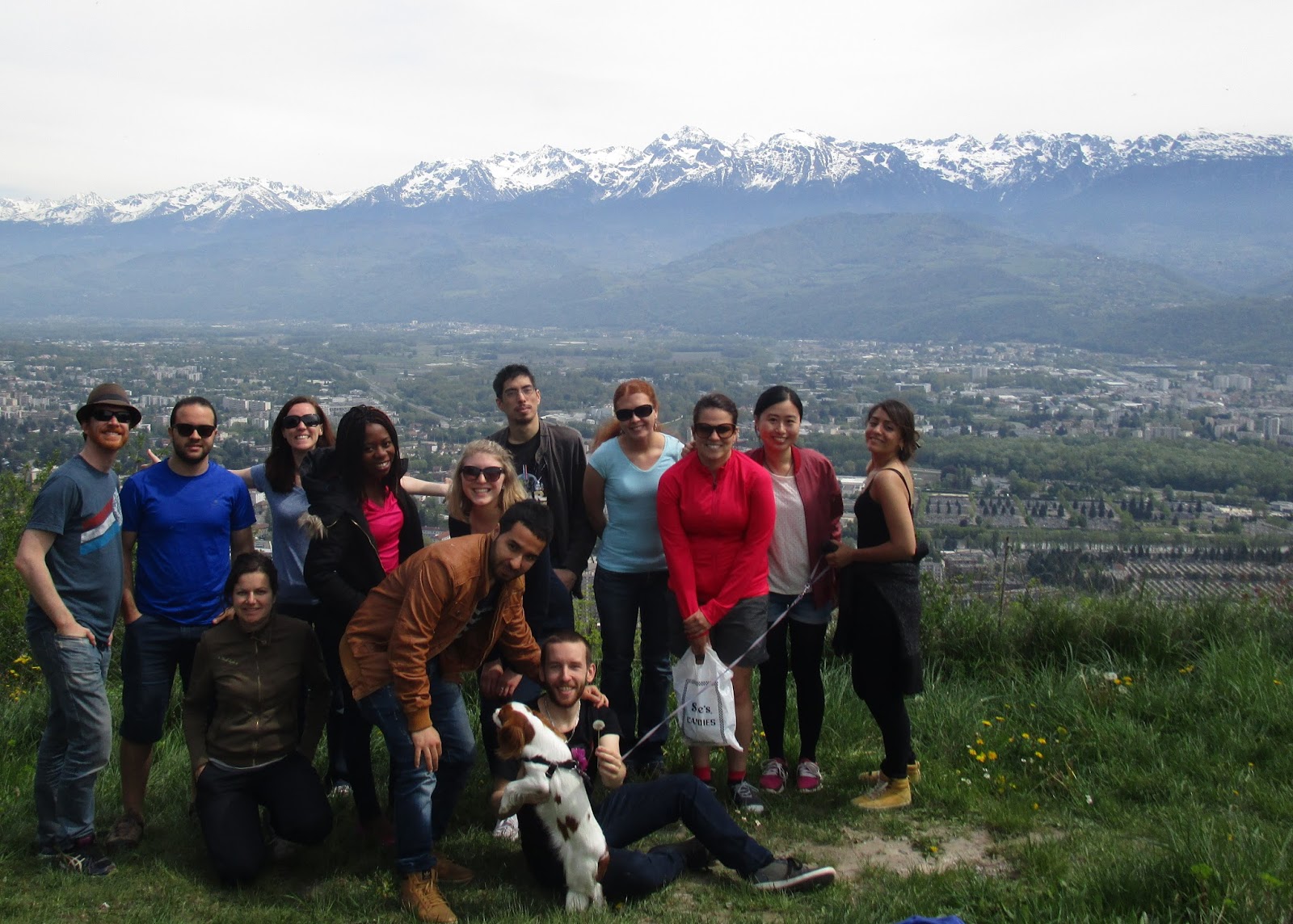
Our time living in Grenoble is drawing to a close. We leave in 45 days to be exact. That date seems far too soon. For months now, I have been "pre-grieving" our eventual departure from Grenoble. Looking at the mountains surrounding town, walking home from the boulangerie, drinking chocolat viennois with friends on Friday nights, I have been cognizant of the coming end to each of these. It has been an important process for me.

About a month ago, I moved emotionally into a time of wanting to "rip the band-aid off." The move is coming, it is going to hurt, let's just get it over with. Now, when I think about leaving, it makes my head spin. I feel sort of dizzy at the idea.

Have you noticed how emotions are not mutually exclusive? We can sometimes have this immature idea that feeling one emotion, like being sad to leave Grenoble, means I cannot simultaneously feel a "contradictory" emotion, like being excited to move back near friends and family and start a wonderful new job. Praise God that He made us emotionally complex enough to feel a myriad of emotions at the same time. I am both deeply saddened to leave Grenoble and our wonderful community here and very excited for our adventures ahead in California.

The only difference is that at this moment in time, while still in Grenoble, the emotions about leaving are much more tangible than the ethereal thoughts of what is to come. Also, our community around us now is experiencing the sadness of our leaving and it is important to identify with them in their sadness. It is always harder to be the one left than the one leaving; leaving has novel excitement, remaining only has loss. So for those of you in California, our time of rejoicing together will come, but for now I am grieving in Grenoble.

It is also hard that we will leave Grenoble with work left to be done. Granted, there will always be more friends and university students to hang out with no matter when we leave, but it is sad to go when there are so many wonderful people here now. But the idea of ever leaving a place with “mission complete” is a fantasy. Aside from very finite projects, life is never “complete.” There are still numerous things we want to do in Grenoble and in France, but this only means we will have to come back to visit.